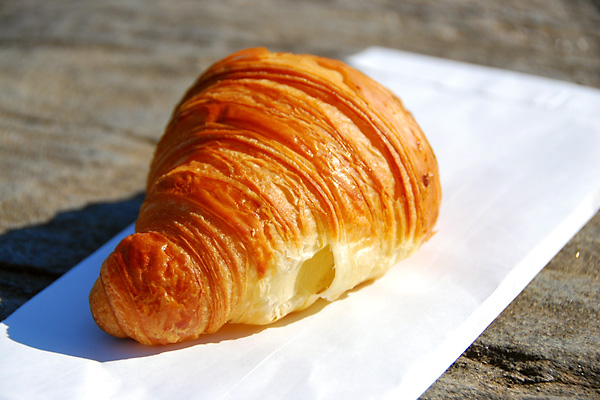
After eating a full breakfast of goat's cheese (chevre) on toast with yogurt and a hard-boiled egg, I planned on walking North to the Sacre Coeur Basilica in Montmartre but, stepping outside into the miserably cold and rainy Paris day, I decided to venture East to the Centre Pompidou to see some modern art. Although I had been to several museums in a short number of days in London, I felt like I had given them enough of a break to see another. Plus the walk to the Pompidou is considerably shorter than that to the Sacre Coeur (I didn't want to hassle with the Metro today).
As I approached the Pompidou I really didn't feel like going in and seeing a box in a room with a light flicking on and off and watching people sit on benches looking at the box contemplatively for however long they felt necessary to come off as cultured. So I continued walking, hanging a right toward the Marais district: the historically Jewish quarter of Paris.
On Sunday in Paris, 200 people gathered at the Champs Elysees to protest the air strikes on Gaza from Israel, another estimated 1,300 joined an anti-Israel protest in the Barbes area of the city.

Protest at the Champs Elysees
People told me before I came to Paris to be careful considering I'm a Jew now living in France. Even after the protests this past weekend, I felt safe, even proud, to walk along a street where butchers and patisseries have beautiful French names below which the word "Cacher" is emblazoned.
Not wanting to get completely wet, I stepped into The Museum of Jewish Art and History, housed in an old French mansion from which several Jews were rounded up during the German occupation of France, thirteen of whom died in the death camps.

Courtyard of the Museum of Jewish Art and History
Understandably, there was high security to enter the museum, heightening the fact that it was propitious time to visit. The first room you step into explains how many times the Jews were expelled from different countries in Western Europe and how they were recalled (often only to be expelled again a few years later). Throughout the permanent exhibitions there are placards with photos of contemporary French Jews and a short statement of what being Jewish means to them alongside outstanding examples of Jewish artifacts from the beginnings of Jewish history in Europe right through to the present.
While at the British Museum in London, I found some collections interesting or just pleasant to look at but never felt excited by what I saw. Today, looking at a Haggadah from hundreds of years ago, I was moved. I read the words. They were the exact same words that we read every year. Nothing changed. I looked at the hand-drawn images, also there to guide children along the story of Passover just like today. It became clear that the same ideals held by Jewish people today were the same back then, even while being expelled from land to land. Being Jewish is about being a part of a history to be passed on.

A Sukkah, hundreds of years old
After stepping outside and thinking about the current situation in Israel and the protests that took place right around the corner from where I live, one particular quote from one of the placards inside the museum, written by Abel Rambert, struck me:
Judaism is like a ball. The harder you hit it, the higher it bounces.
On my way home I decided to see something completely different and stepped inside an old cathedral on a side street in which they were setting up for a concert. It was a beautiful building. They offered me a seat for the show later on.

The cathedral I stepped into


_(1).jpg/758px-Manet,_Edouard_-_Le_D%C3%A9jeuner_sur_l'Herbe_(The_Picnic)_(1).jpg)